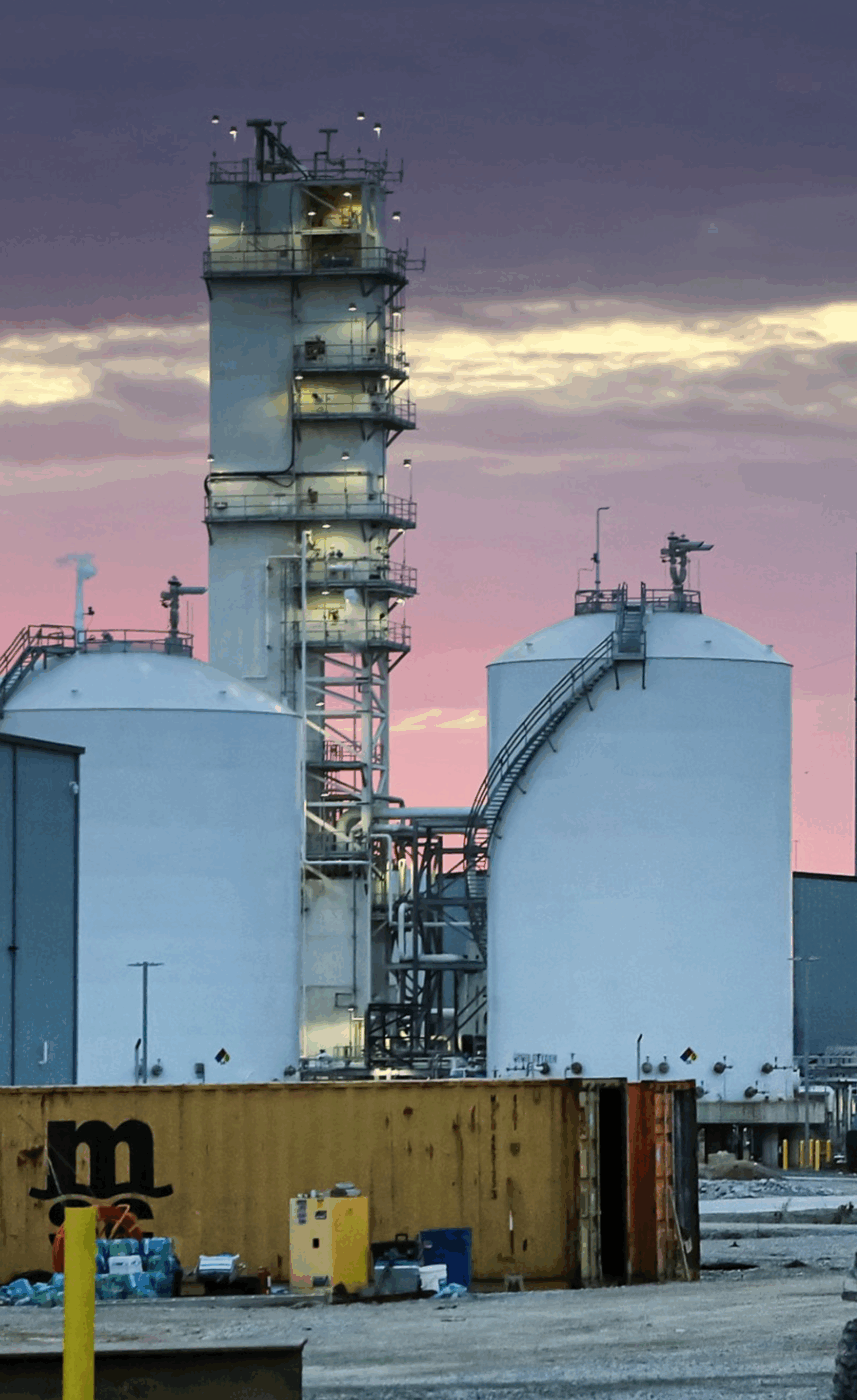
Full-service supplier of air separation plants, oxygen and nitrogen generators and CO2 plants. Gas & liquid supplier to end users and to distributors of bulk liquids & packaged gases. Air: Source of the industrial gas products oxygen, nitrogen and argon

Overview of Cryogenic Air Separation
and Liquefier Systems

Cryogenic air separation processes are routinely used in medium to large scale plants to produce nitrogen, oxygen, and argon as gases and/ or liquid products. 

Cryogenic air separation is the preferred technology for producing very high purity oxygen and nitrogen. It is most cost effective technology for high production rate plants.  All liquefied industrial gas production plants utilize cryogenic technology to produce liquid products.

The energy required to operate a cryogenic plant depends on the product mix and required product purities.  It requires more power to produce oxygen than nitrogen, and more than twice as much power to produce these products as liquids rather than as gases.


General Process Description - Cryogenic Air Separation
     Nitrogen Plants vs. Oxygen Plants
     Argon Recovery and Purification
     Product Compression and Alternatives
     LIN-Assist Plants
Liquefiers
     Stand-alone Liquefiers
     Integrated Liquefiers
     Campaign mode operation
Supply System Optimization
 

Air - The Raw Material for Making Nitrogen, Oxygen and Argon:

 
Dry air is relatively uniform in composition, with primary constituents as shown below. Ambient air, may have up to about 5% (by volume) water content and may contain a number of other gases (usually in trace amounts) that are removed at one or more points in the air separation and product purification system.
 
Primary Components of Dry Air
Gas % by Volume % by Weight Parts per Million (V) Chemical Symbol
Nitrogen 78.08

75.47

780805 N2
Oxygen 20.95 23.20 209450 O2
Argon 0.93 1.28 9340 Ar
Carbon Dioxide 0.038 0.0590 380 CO2
 

General Process Description - Cryogenic Air Separation: 

 
There are many variations in the air separation cycles which are used to make industrial gas products.  Design variations arise from differences in user requirements.  Process cycles are somewhat different depending upon how many products are desired (either nitrogen or oxygen, both oxygen and nitrogen, or nitrogen, oxygen and argon); required product purities; gaseous product delivery pressures; and whether one or more products will need to be produced and stored in liquid form.

All cryogenic air separations consist of a similar series of steps.  Variations reflect the desired product mix (or mixes) and the priorities/ evaluation criteria of the user.  Some designs minimize capital cost, some minimize energy usage, some maximize product recovery, and some allow greater operating flexibility. 

The cryogenic air separation flow diagram shown below illustrates (in a generic fashion) many of the important steps in producing nitrogen, oxygen and argon as both gas and liquid products.  It does not represent any particular plant.


Steps in Cryogenic Air Separation:


The first process step in any air separation plant is filtering and compressing air (most commonly, to about 90 psig, or 6 bar). The compressed air is then cooled to close-to-ambient temperature by passing through water-cooled or air-cooled heat exchangers.  Sometimes it is cooled to a somewhat lower temperature in a mechanical refrigeration system.  This improves the efficiency of impurity removal, minimizes power consumption, and leads to less variation in plant performance due to seasonal changes in atmospheric temperature.  Condensed water is removed from the air after each stage of compression and cooling.  

The next step is removing the remaining water vapor and carbon dioxide.  These components of air must be removed to meet product quality specifications. In addition, they must be removed prior the air entering the distillation portion of the plant, where the very low temperature would cause the water and carbon dioxide to freeze and deposit on the surfaces within the process equipment. There are two basic approaches to removing the water vapor and carbon dioxide - "reversing exchangers" and "molecular sieve units".  

Most new air separation plants employ a “molecular sieve” "pre-purification unit" (PPU) to remove carbon dioxide and water from the incoming air by adsorption onto the surface of "molecular sieve" materials at near-ambient temperature. The units can also be designed to remove other contaminants, such as hydrocarbons, which may be found in an industrial environment. The adsorbent material is typically contained in two vessels.  One vessel is used to purify the air while the other is being regenerated.  The two beds switch service at frequent intervals.  Molecular sieve pre-purification is the natural choice when a high ratio of nitrogen recovery is desired.  

The second approach uses “reversing” heat exchangers to remove water and CO2.  Cold absorption units integrated with the distillation system are used to remove hydrocarbons. Reversing exchangers remain cost effective for some smaller production rate nitrogen or oxygen plants.  In reversing heat exchanger plants, the initial cooling of the air is done in the reversing exchangers, where the incoming air is cooled to a low enough temperature that the water vapor and carbon dioxide freeze out onto the walls of the brazed aluminum heat exchanger air passages.  At frequent intervals, a set of valves reverse the duty of the the air and waste gas passages. After an incoming passage has been switched to exiting gas service, the waste gas evaporates the water and carbon dioxide ices that were deposited during the last air cooling period.  This returns the water vapor and carbon dioxide to the atmosphere, and readies the passage for return to incoming air cooling service. 

Whichever front end cleanup system is used, the next step is additional heat transfer against product and waste gas streams to bring the air feed to cryogenic temperature (approximately -300 degrees Fahrenheit or -185 degrees Celsius).  This cooling is done in brazed aluminum heat exchangers which allow the exchange of heat between the incoming air feed and cold product and waste gas streams exiting the separation process.  The exiting gas streams are warmed to close-to-ambient air temperature.  Recovering refrigeration from the gaseous product streams and waste stream minimizes the amount of refrigeration that must be produced by the plant, however additional cooling is needed.  The very cold temperatures needed for cryogenic distillation are created by a refrigeration process that includes expansion of one or more elevated pressure process streams.   

The next process step is the use of distillation columns to separate the air into desired products.  To make oxygen as a product, the distillation system will have both “high” and “low” pressure columns.  Nitrogen plants may have only one column, although many have two.  Nitrogen leaves the top of each distillation column; oxygen leaves from the bottom.  Argon has a boiling point similar to that of oxygen and will preferentially stay with the oxygen product. If high purity oxygen is required, argon must be removed from the distillation system at an intermediate point. Impure oxygen produced in the initial (higher pressure) column is further purified in the second, lower pressure column. 

Plants which produce high purity oxygen require more distillation stages and the removal of argon from a point in the low pressure column where its concentration is highest.  The removed argon is usually processed in an additional "side-draw" crude argon distillation column that is integrated with the low pressure column. Crude argon may be vented, further processed on site, or collected as liquid and shipped to a remote "argon refinery". The choice depends upon the quantity of argon available and economic analysis of the various alternatives.      

Pure argon is typically produced from crude argon by a multi-step process. The traditional approach is removal of  the two to three percent oxygen present in the crude argon in a “de-oxo” unit.  These small units chemically combine the oxygen with hydrogen in a catalyst-containing vessel. The resultant water is easily removed (after cooling) in a molecular sieve drier. The oxygen-free argon stream is further processed in a "pure argon" distillation column to remove residual nitrogen and uncombined hydrogen.

Advances in packed-column distillation technology have created a second argon production option, totally cryogenic argon recovery that uses a very tall (but small diameter) distillation column to make the difficult argon/ oxygen separation. The amount of argon that can be produced by a plant is limited by the amount of oxygen processed in the distillation system; plus a number of other variables that affect the recovery percentage. These include the amount of oxygen produced as liquid and the steadiness of plant operating conditions. Due to the naturally-occurring ratio of gases in air, argon production will be less than 4.4% of the oxygen feed rate (by volume) or 5.5% by weight.  

The cold gaseous products and waste streams that emerge from the air separation columns are routed back through the front end heat exchangers.  As they are warmed to near-ambient temperature, they chill the incoming air.  As noted previously, the heat exchange between feed and product streams minimizes the net refrigeration load on the plant and, therefore, energy consumption. 

Refrigeration is produced at cryogenic temperature levels to compensate for heat leak into the cold equipment and for imperfect heat exchange between incoming and outgoing gaseous streams.  Air separation plants use a refrigeration cycle that is similar, in principle, to that used in home and automobile air conditioning systems.  One or more elevated pressure streams (which may be nitrogen, waste gas, feed gas, or product gas, depending upon the type of plant) are reduced in pressure, which chills the stream. To  maximize chilling and plant energy efficiency, the pressure reduction (or expansion) takes place inside an expander (a form of turbine).  Removing energy from the gas stream reduces its temperature more than would be the case with simple expansion across a valve.  The energy produced by the expander is put to use to drive a process compressor, an electrical generator, or other energy-consuming device such as an oil pump or air blower. 

Gaseous products normally emerge from the plant at relatively low pressures, often just over one atmosphere (absolute).  In general, the lower the delivery pressure, the higher the plant efficiency.  When products will be used at relatively low gauge pressure (up to several atmospheres) plants can be designed and operated to produce product at the required pressure. In most cases, however, it is more cost effective to produce the product at low pressure and use a blower or compressor to achieve required delivery and gaseous storage pressures. 

If gaseous oxygen is required at moderate pressure, a process option is to use a "LOX boil" or "pumped LOX" cycle.  These process cycles vaporize liquid oxygen at just above delivery pressure, after withdrawal it from the distillation column and pumping to the desired pressure (if necessary).  These cycles have appeal because oxygen compressors are expensive to purchase and install.

To achieve energy-efficient vaporization of the product oxygen, a portion of the air feed, which is almost 80% nitrogen, must be compressed to higher than normal pressure. The required booster compressor is often integrated with the main air compressor. Because the heat for vaporizing and warming the vaporized LOX is drawn from the air feed, which is partially condensed and sent to the distillation system, “Pumped LOX” systems are most applicable when there is fairly constant product demand.   Rapid and repeated changes in demand will negatively affect plant performance, as each sudden change will tend to “bounce” the distillation columns.     

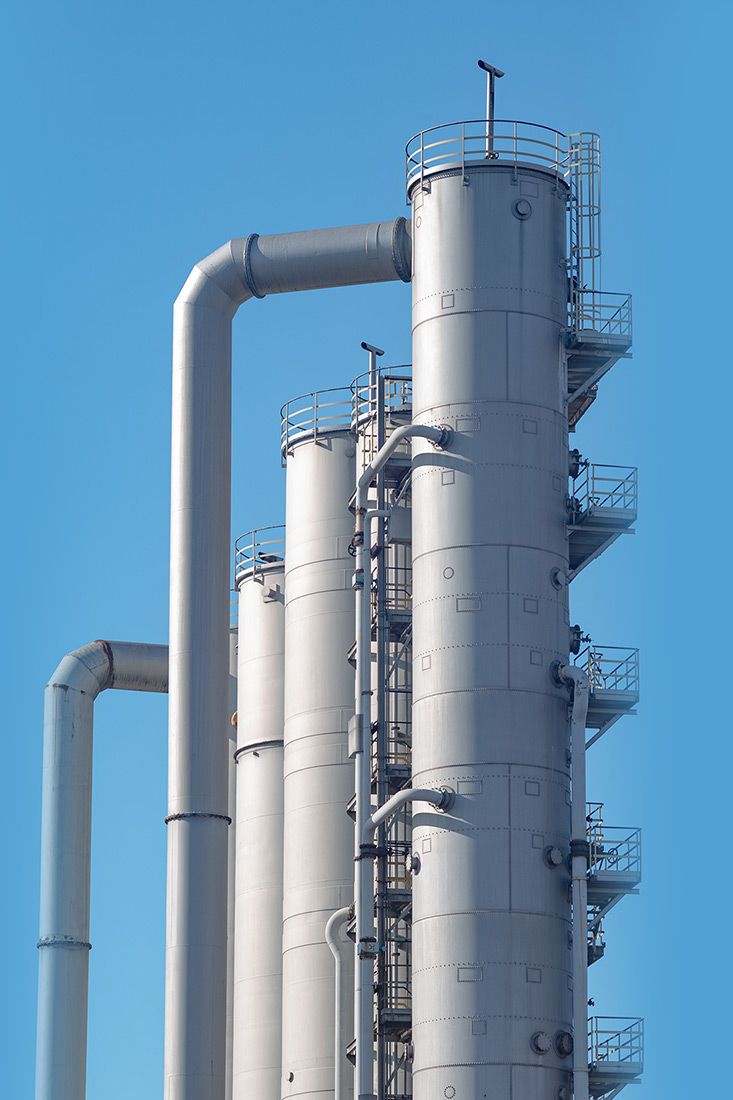
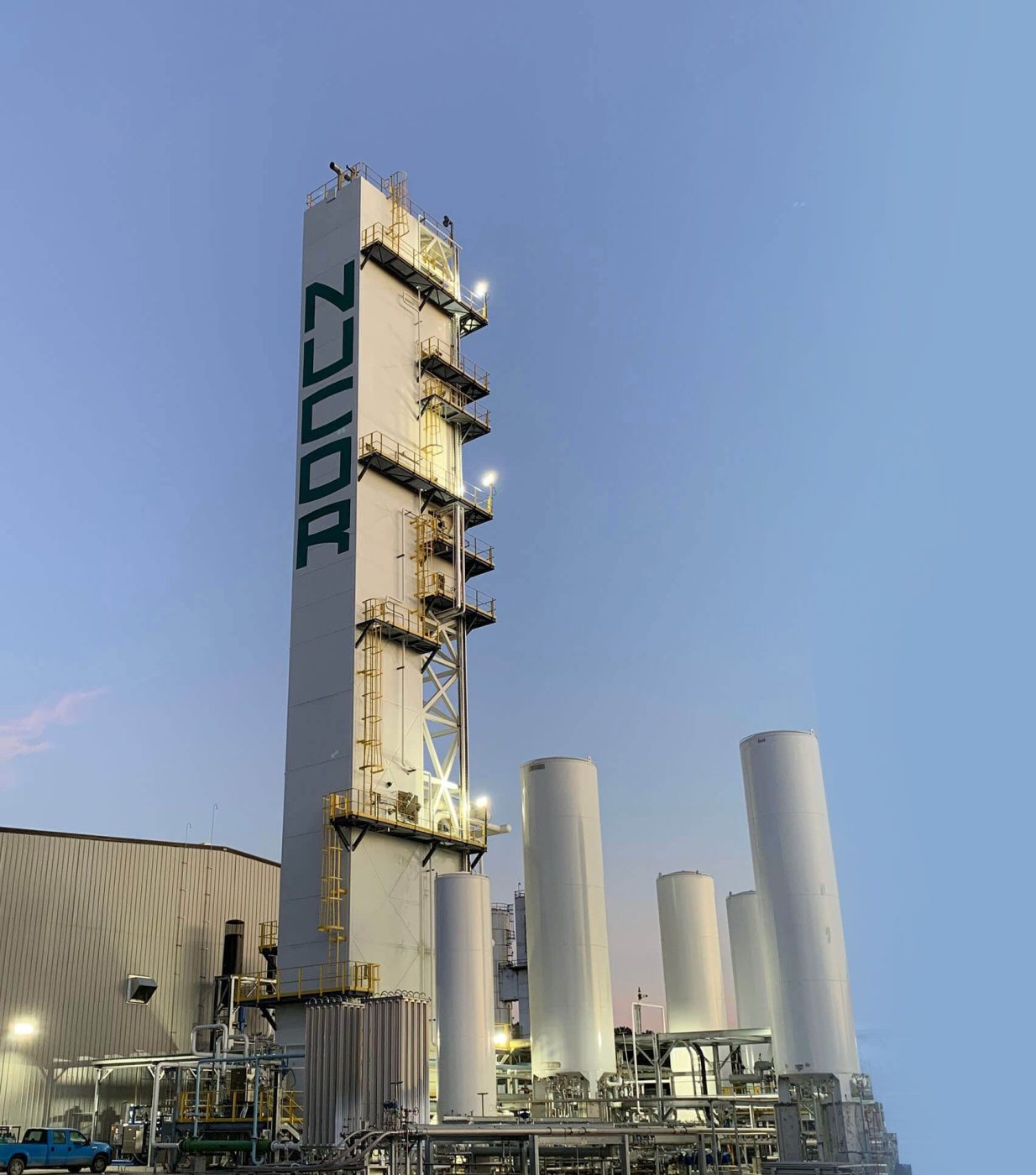
The portions of the cryogenic air separation process that operate at very low temperatures, i.e., the distillation columns, heat exchangers and cold interconnecting piping, must be well insulated.  These items are  located inside sealed (and nitrogen purged) “cold boxes”, which are relatively tall structures that may be either rectangular or round in cross section. Cold boxes are "packed" with rock wool or perlite to provide insulation and minimize convection currents. Depending on plant type and capacity, cold boxes may measure 2 to 4 meters on a side and have a height of 15 to 60 meters.  They may be totally shop fabricated for rapid field erection, or the distillation columns, heat exchangers, and their interconnecting manifolds may shop fabricated for field assembly and erection.  This is done when a shop fabricated box would be too large or heavy to ship to the site.  

LIN assist plants are a special kind of cryogenic plant that can cost-effectively produce gaseous nitrogen at relatively low production rates.  They differ from "normal" cryogenic plants in that they do not have their own mechanical refrigeration system.  They effectively "import" the refrigeration required for on-site nitrogen production from a remote high-volume, high efficiency merchant liquid plant. They accomplish this by continuously injecting a small amount of liquid nitrogen into the distillation process. The "imported" LIN provides reflux for distillation, then vaporizes and mixes with the locally-produced gaseous nitrogen, becoming part of the final product stream.  This arrangement simplifies the plant, reduces capital cost (versus a "normal" cryogenic plant with its own refrigeration cycle) and can, under the right conditions, provide better overall economics than either an all-bulk-liquid supply or a new cryogenic nitrogen plant with a standard internal refrigeration cycle. 


Liquefiers

 
When a large percentage of plant production must be produced as a liquid, a supplemental refrigeration unit must be added to (or integrated into) the basic air separation plant.  These units are called liquefiers and most use nitrogen as the primary working fluid. 

The required liquefier capacity is determined by an analysis that considers local plant backup needs and anticipated demand for merchant liquid products to be supplied out of the plant. As a consequence, the ability to produce liquefied product may range from a small fraction of the air separation plant capacity up to the plant's maximum production capacity for oxygen plus nitrogen and argon. 

The basic process cycle used in liquefiers has been unchanged for decades.  The basic difference between newer and older liquefiers is that the maximum operating pressure rating of cryogenic heat exchangers has increased as cryogenic heat exchanger manufacturing technology has improved. A typical new liquefier can be more energy efficient than one built thirty years ago if it employs higher peak cycle pressures and higher efficiency expanders. 

A classic "stand alone" liquefier takes in near-ambient-temperature-and-pressure nitrogen, compresses it, cools it, then expands the high pressure stream to produce refrigeration.  In some liquefier systems a second refrigeration system using an environmentally-friendly form of refrigerant provides some of the higher temperature duty. 

A classic stand-alone liquefier cycle produces only liquid nitrogen.  If it is desired to produce liquid oxygen, an extra heat exchanger circuit may be provided to re-vaporize some of the liquid nitrogen while liquefying the oxygen product.  Alternatively, in some cases it is possible to return some of the liquid nitrogen to the air separation system and use the contained refrigeration to permit withdrawal of a similar amount of liquid oxygen directly from the plant.

Newer cycles can be more efficient under certain circumstances. When a totally new air separation plant is designed, the liquefier cycle may be closely integrated with the air separation process cycle. This is most advantageous if the plant will make a large amount of liquid product, as in a merchant liquid plant. 

In highly integrated air separation and liquefaction plants, most if not all of the refrigeration for both air separation and product liquefaction is produced in the liquefier section.  Refrigeration is transferred to the air separation section of the plant through heat exchangers and injection of liquid nitrogen as distillation column reflux.  Highly integrated merchant liquid production plants are less expensive to build and more thermodynamically efficient; and they can be very flexible in the sense of allowing production of varying mixes of liquid nitrogen and liquid oxygen. On the other hand, they have a potential disadvantage - the liquefier cannot be shut down independently of the air separation unit.   

Being able to operate the ASU without also operating the liquefier is sometimes very desirable, for instance when liquid inventories are at high levels but a pipeline-supplied gaseous oxygen customer continues to require a large amount of product, or when total liquid demand is consistently less than the full plant capacity.  In these cases plants with independent liquefiers may be operated in what is commonly called a "campaign" mode - where periods of full capacity operation of the liquefier are alternated with periods when the liquefier is idled.

Campaign operations take advantage of the facts that liquefiers are most energy efficient when operating near full capacity and that shutdown and startup of an independent liquefier system can be done relatively easily and with little adverse impact on air separation plant operation.  When the efficiency savings available with campaign operation are coupled with production run timing that takes advantage of lower-cost power periods (nights, weekends, etc.), significant operating cost savings can be achieved versus constant operation at reduced liquid production rates.


More on Air Separation and Supply System Optimization:

 
Inter-relationships between the anticipated level of customer demand, production technology and product delivery mode are reviewed on our Delivery Methods and Plant Selection and Optimization pages. 
 
Air Separation
 Overview
Non-Cryogenic
Technologies
Supply
& Delivery
System
Optimization
UCG Onsite
Gas Supply

Changing
Supplier

 
Links to UIG Products and Services
 
UIG Products and Services  UIG New Plant Supply New Cryogenic Air Separation Plants & Liquefiers Engineering Services Reconditioned Plants
 

Universal Industrial Gases, Inc.
Universal Cryo Gas, LLC
2200 Northwood Ave. Suite 3
Easton, Pennsylvania 18045-2239 USA

Phone (610) 559-7967 Fax (610) 515-0945

All material contained herein Copyright 2003 / 2007 UIG.